Lipödem Tedavisi: Kansız, Yağ Emboli Riski Olmayan, Lenf Koruyucu Superdry 4D
What is lipedema?
Commonly known as ‘Painful Cellulite‘ or ‘Leg Obesity’, lipedema is a chronic fat metabolism disease that does not respond to diet and exercise. We typically characterize it by disproportionate fat accumulation in the hips, thighs, and legs. Lipedema treatment protocols should address this condition not only as an aesthetic issue but also as a metabolic syndrome. In fact, the term lipedema does not fully define the disease. It is a syndrome that affects not only adipose tissue but also blood vessels, sensory nerves, lymphatics, and connective tissue, with systemic effects primarily on the thyroid.
Prof. Dr. Ahmet Karacalar; it defines this condition not only as an aesthetic flaw but also as a metabolic and hormonal syndrome. Superdry4D (Bloodless, with no risk of fat embolism) Technique, stands out as a highly safe surgical approach that removes painful fats from the body without damaging the lymphatic system.

What Are the Symptoms of Lipedema?
If you are experiencing the complaints below, you should seek expert evaluation without delay. Especially the following symptoms allow us to make a diagnosis:
- Disproportionate Body: While the upper body is thin, the lower body (hips and legs) remains noticeably thick.
- Resistant Fat: No matter how much diet and exercise you do, unfortunately your thick legs do not slim down.
- Pain and Sensitivity: You feel pain when you touch your legs or experience severe pain at the end of the day.
- Easy Bruising: Unexplained bruises occur on the legs even with the slightest impact.
- Stemmer Sign: If the skin of the toes can be pinched with tweezers, this is in favor of the disease. Otherwise (if it cannot be pinched) we evaluate it as Lymphedema.
- These are the main complaints. Most patients also experience numbness in the legs, restless legs, coldness in the feet, or conversely burning, intestinal issues, low energy, and thyroid problems.
Types of Lipedema (Areas of Spread)
We classify the disease into 5 different types according to the areas it affects in the body. Therefore, we need to determine the type for proper treatment planning:
Type 1: Hip and Thigh Area
Fat accumulation is only in the pelvic, hip, and thigh areas. The skin surface usually appears smooth, but the disproportion between the upper and lower body is noticeable.
Type 2: Lipedema Extending to the Knee
Fat accumulation starts from the hips and extends down to the knees. Additionally, fat deposits (pads) form in the inner knees, which can cause the legs to rub against each other while walking.
Type 3: Up to the Ankle (Pants Type)
This is the most common form we encounter. There is thickening from the hips to the ankles. A bulge called “Lipedema Cuff” forms at the ankles; however, we do not see swelling in the feet.
Type 4: Involvement of the Arms
The disease affects not only the legs but also the arms. The affected arm is usually associated with Type 2 or Type 3. We observe thickening and sagging up to the wrists.
Type 5: Only Lower Leg (Below the Knee)
We encounter this less frequently. We only detect fat accumulation between the knee and the ankle.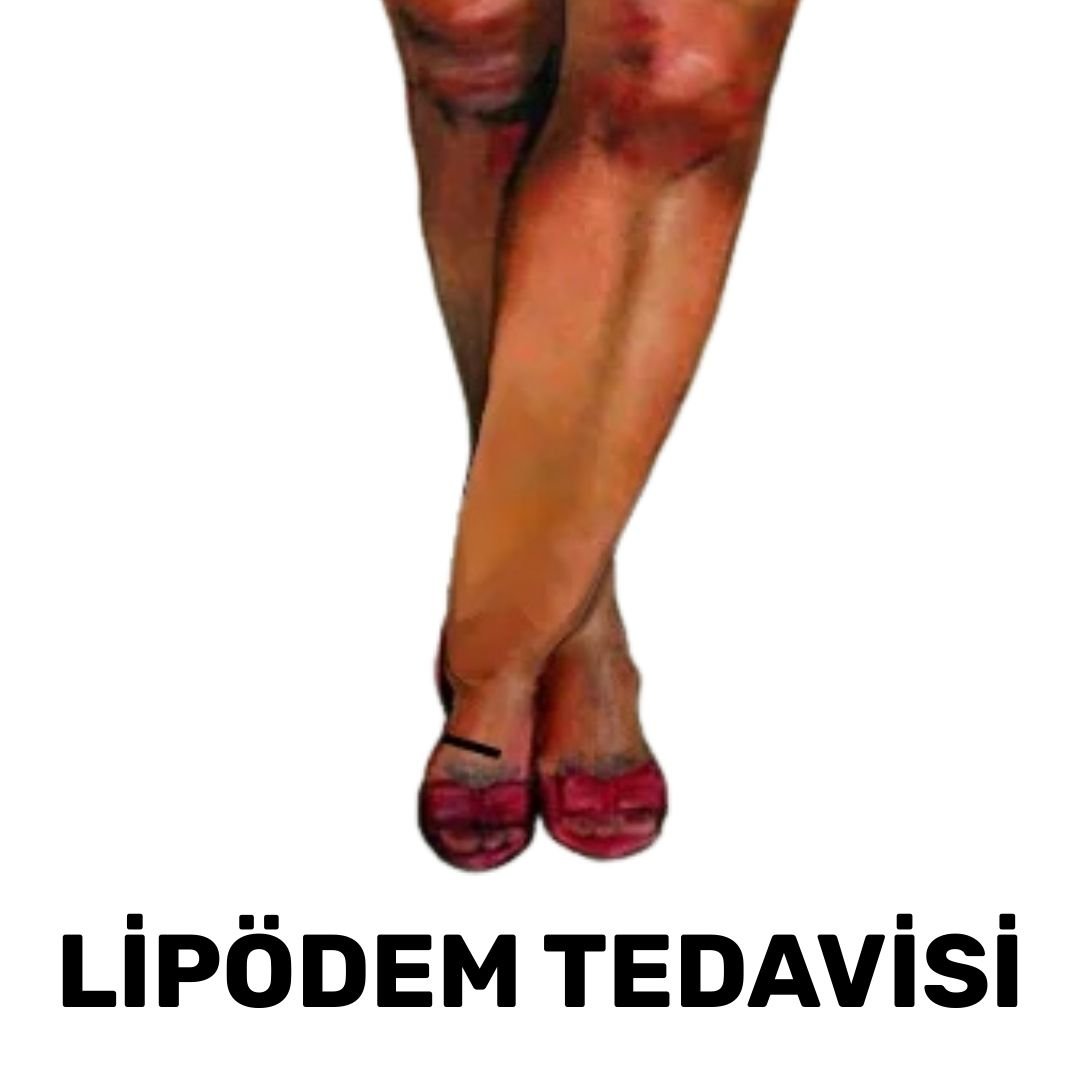
Stages of the Disease in Planning Lipedema Treatment
This disease has a progressive character. If we do not intervene in time, you will experience transitions between stages:
- Stage 1 (Initial): The skin surface still appears smooth, but the subcutaneous fat tissue has increased. You will notice swelling that increases throughout the day.
- Stage 2 (Progression): Waves on the skin surface become more pronounced, and the “orange peel” appearance increases. Hard fat nodules the size of walnuts can be felt under the skin.
- Stage 3 (Advanced Stage): Large fat masses and sagging occur in the legs. You may experience difficulty walking and develop sores due to friction.
- Stage 4 (Lipo-Lymphedema): The disease is no longer just a fat tissue problem; the lymphatic vessels have also been damaged. As a result, lymphedema accompanies the condition.
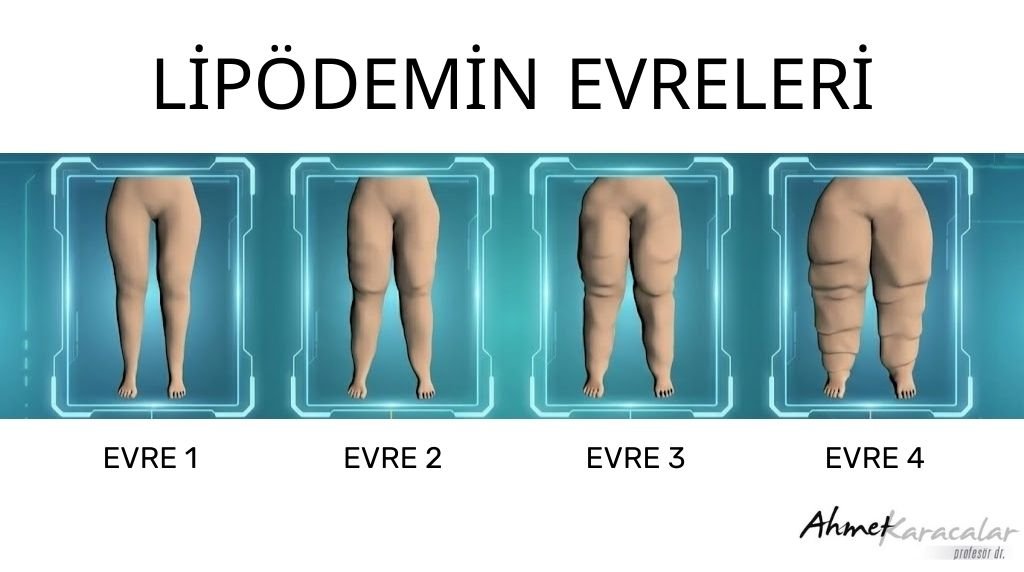
Changes observed according to stages in lipedema disease.
Lipedema Treatment: Superdry 4D liposuction (Bloodless, No risk of embolism, Lymph preserving)
For the permanent treatment of the disease, the diseased fat tissue must be surgically removed from the body. The advantages of the Superdry 4D Technique developed by Prof. Dr. Ahmet Karacalar, which has been published in international peer-reviewed journals and presented at conferences (Singapore and Thailand), are as follows.
- Bloodless: Thanks to the special tourniquet system, we work in a bloodless environment.
- Lymph Protecting: With longitudinal techniques and fine flexible cannulas, lymphatic vessels are not damaged; on the contrary, since the fat load is removed, the lymphatic system is relieved.
- 1. Safe Borders: 2. Since fat is taken without blood, we take the maximum safe amount of fat in a single session.
- 3. Instant Result: 4. Since there is no swelling (edema) during the procedure, we see the result instantly and it is possible to aesthetically shape the leg.
- 5. There is no risk of fat embolism.
Other Methods (Laser, Ultrasonic, PAL, Waterjet)
- 8. Laser Lipolysis: 9. It uses heat energy. For this reason, it carries the risk of heat damage and color darkening in thin leg skin.
- 10. Ultrasonic: 11. There is a risk of heat damage. It carries the risk of nerve damage by affecting the fat in the nerve sheaths. It also poses a risk of burns in the tissue.
- 12. The safety limit of PAL and water jet techniques is higher.
Frequently Asked Questions
Does lipedema go away without surgery?
No. It is not obesity, so it does not respond to diet and exercise. We need to surgically remove the diseased fat tissue. Non-surgical methods only alleviate the symptoms, they do not treat it.
How to do a lipedema diet?
This diet is not a standard weight loss diet. On the contrary, our goal here is not to count calories, but to reduce inflammation in the body. This tissue is ‘resistant to starvation’, but with proper nutrition, we can control pain and edema.
What should a lipedema patient avoid eating?
First of all, we recommend an anti-inflammatory diet. You should especially stay away from foods containing phytoestrogens, processed sugar, and gluten as much as possible during the pre-menopausal period.
Is walking and sports good for you?
13. Exercise increases circulation but does not dissolve diseased fats. We generally recommend horizontal exercises like swimming. However, 14. you should avoid heavy sports that put strain on the knee joint. 15. It is not just simple regional fat accumulation; it is a genetic-based, progressive fat tissue disorder. Home methods only provide pain comfort by reducing edema. As a result,.
How is lipedema removed from the body?
The only way to control the disease is to remove the diseased fat tissue from the body. If the fats taken with the Superdry method comply with the given program and do not experience any hormonal issues, they do not reoccur.
Does compression stockings help?
A compression stocking can reduce payment but is not sufficient. We prefer to use special flat-knit compression garments in treatment.
Does hot water, sauna, or thermal bath help?
No, the disease does not like heat. Spa, sauna, or sunbathing increases swelling and triggers complaints. You should also avoid thermal (heat-generating) tightening devices.
Does gastric sleeve surgery slim the legs?
No. This fat resists stomach reduction surgeries. Even if the patient loses significant weight from the upper body, their legs remain thick and the disproportion becomes even more pronounced.
Does lipedema surgery recur?
Since we remove the diseased fat tissue using the Superdry method, we aim for the results to be permanent and for it not to recur in the same area if you adhere to the lifestyle we recommend.
Is Non-Surgical Lipedema Treatment Possible?
In the medical literature, we define it as a fat metabolism condition based on genetics and hormones. Therefore, it is not possible to completely eliminate the affected tissue solely through diet or exercise.
Does Lipedema Go Away with Home Treatment?
16. we need surgery for the permanent correction of the ankle 17. and leg shape. 18. Lipedema surgery is not a standard fat removal procedure; it is a comprehensive treatment that includes regenerative methods aimed at improving skin quality, taking into account the health issues, weight, and psychological problems of lipedema patients, and includes a program aimed at preventing the recurrence of the disease. We determine pricing specifically for each individual based on the stage of the disease and the number of areas where the procedure will be performed, such as legs, arms, or hips.
Lipedema Treatment Prices 2026
19. It is common for lipedema patients to have X-shaped knees and inward turning, which puts excessive strain on the joint. Intra-knee fat accumulation is an important reason for this. There is a gradual collapse of the arch of the foot, and the walking mechanics change.
Knee joint problems in lipedema?

Patients with lipedema often experience X deformation and inward turning of the knees, and excessive load is placed outside the joint. Intra-articular fat accumulation is an important reason for this. There is a gradual collapse of the arch of the foot, and the walking mechanics change.
There is anabolic resistance in lipedema, meaning that muscle strengthening is more difficult. Especially in the quadriceps and hip abductors. Muscle weakness is common. This further exacerbates the problem.
When joint misalignment progresses to chondromalacia (softening of the cartilage in the knee), synovitis (inflammation of the membrane) develops in the joint capsule.
The patient's “lipedema knee pain” is due to both inflammation of the adipose tissue and synovitis of the joint.
Solution: First and foremost, the removal of fat around the knee and intra-articular stem cell injection in the same session is very important.
The removal of fat around the knee greatly contributes to the correct alignment of the knee, relieving knee joint functions.
Stem cells can produce new cartilage at the site they are given. They stop joint inflammation and improve blood flow in the joint. It has been found that they increase joint lubrication and enhance joint functions.
Strengthening the right muscles on top of these two treatments is another important step.
THIN-DEFINE-REPAIR-STRENGTHEN.
What Are the Differences Between Lipedema and Lymphedema?
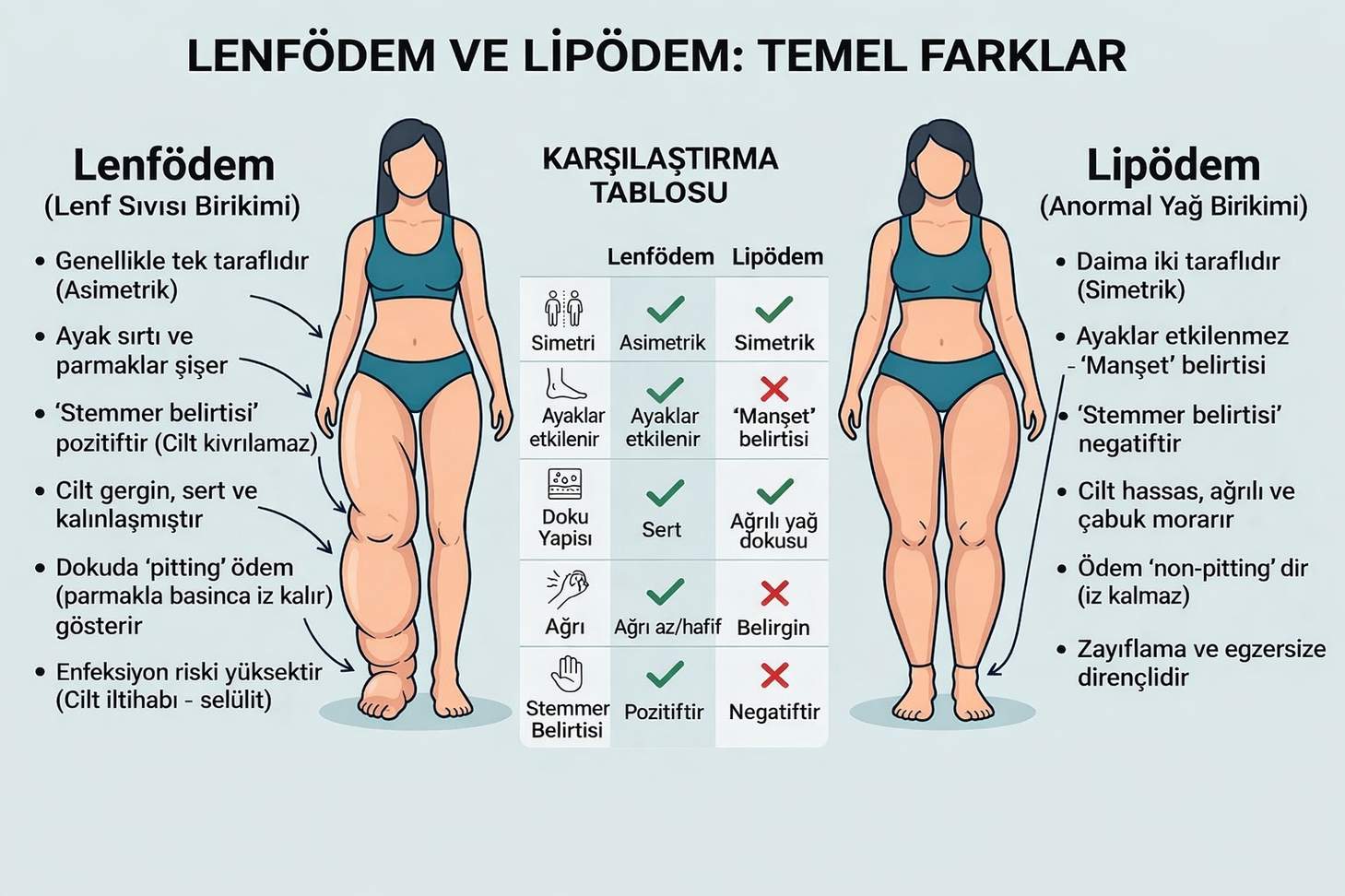
A comparison infographic showing the differences between lipedema and lymphedema; symmetry, foot retention, Stemmer's sign, pain, and tissue structure are compared.
For this, the flexibility of the toe's back is examined. If it is not flexible, very stiff, and not compressible, this is in favor of lymphedema. Previously, it was said that lipedema does not affect the foot. However, from our experiences, we can say that it can progress up to the middle of the foot.
How is lipedema and lymphedema distinguished by examination?

Note: Although lipedema is often confused with lymphedema, the “Stemmer's sign” (the inability to lift the skin of the second toe) is not seen in lipedema.
WHAT IS LIPOEDEMA STOCKING?
🦵CCL3 flat knit compression sock is a special high-pressure medical sock used in lipoedema.
🦵CCL indicates the pressure level.
Flat-knit stockings are prepared using a special production technique. These stockings are thicker, more durable, and less elastic compared to other stockings. Due to these features, they better support the leg tissue and are more effective in edema control.
🦵Therefore, in lipedema, flat-knit compression stockings are preferred..
🦵Lymphatic circulation in lipedema may be affected over time. Compression stockings can help improve circulation by supporting the upward movement of lymph fluid.
🦵Many lipedema patients experience pain, tenderness, and a feeling of pressure in their legs. The stable support provided by flat-knit stockings may contribute to the reduction of these complaints.
Flat-knit stockings can help the leg shape appear more balanced by tightly wrapping the tissue. This also limits the outward expansion of the tissue.
🦵It can slow the progression of the disease.
1. 🦵Socks should generally be worn in the morning hours, before swelling occurs in the legs. This way, compression becomes more effective.
2. 🦵Socks are mostly worn throughout the day and removed before going to bed in the evening. However, the duration of use may vary according to the doctor's recommendation.
3. 🦵Flat-knit compression socks are provided according to individual measurements.
4. 🦵If used incorrectly, they can cause pain, numbness, and skin irritation.
5. 🦵An incorrect sock does not provide adequate compression, can cause the sock to slip or fold, and may lead to circulation problems.
6. 🦵During walking or exercise, the leg muscles contract and relax. This situation 7. creates a mechanism called the muscle pump. 8. 🦵Compression socks support this mechanism.
9. 🦵Therefore, it is recommended that the patient be active when wearing the socks.
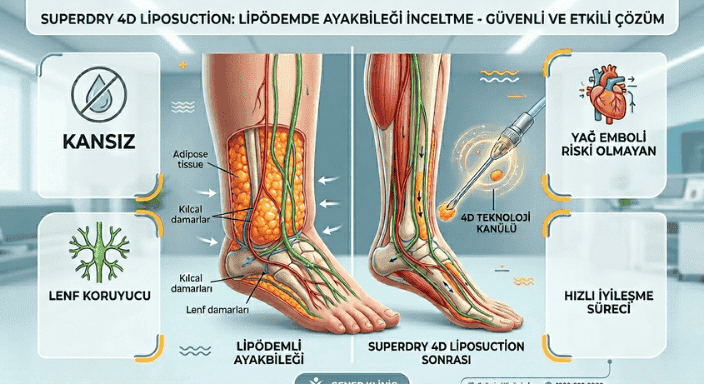
10. Comparison of ankle thinning with the Superdry 4D liposuction method for lipoedema and post-procedure appearance. 11. A treatment that reveals the Achilles appearance with a bloodless approach, without the risk of fat embolism, and lymph-preserving is possible with Superdry 4D liposuction. Ankle thinning may not be limited to the ankle. Depending on the situation, it may progress upwards or towards the dorsum of the foot.

What is ankle slimming with Superdry 4D liposuction?
12. CNN Türk: If You Can't Lose Weight, the Reason May Be Your Lack of Appetite!
13. Milliyet: If You Can't Lose Weight, Your Genetic Code May Be to Blame.

News from the National Press
Dr. Karacalar's Books
To examine Prof. Dr. Ahmet Karacalar's philosophy of aesthetic surgery and the scientific works he has written Dr. Karacalar's Books you can visit the page.