Breast Aesthetics and Proportions
A woman considering breast aesthetics should know the measurements related to the ideal breast. Otherwise, she will pursue the wrong image of the ideal breast she has formed in her mind due to prejudices, misinformation, or conditioning. Knowing what the ideal breast is like allows a person who wants breast aesthetics to make the right requests from their doctor. It also contributes to better and healthier evaluation of the breast after the procedure.
Ideal breast shape
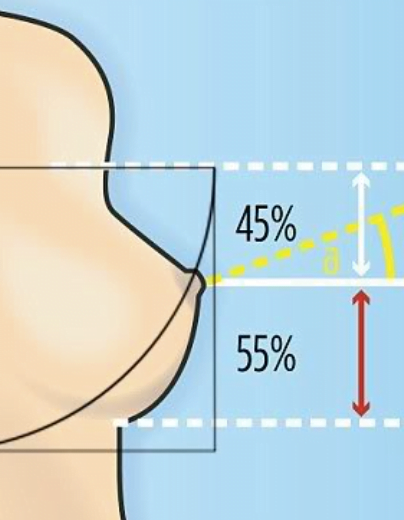
Although the ideal breast shape varies according to the person and culture, the breast known as the alpha breast, where the lower section is fuller, is accepted as the standard. However, the important point here is the upper pole to lower pole ratio. A scientific study reported in the American Journal of Plastic Surgery concluded that this ratio is preferred to be 45% upper pole, 55% lower pole. Considering this ratio in breast lifting, reduction, or augmentation procedures will result in a more natural breast shape.
Evaluating breast aesthetics with neighboring structures, such as arm, upper abdomen, and armpit ratios, is important for achieving holistic aesthetics. Although trends related to breast shape and volume change somewhat over time, the ideal breast shape today is known as the alpha breast, which has a slightly concave upper section and a convex lower section. The nipple should be parallel to the ground. The breast shape defined as a teardrop breast is useful in indicating that the breast volume should be more in the lower half. However, it cannot define the ideal breast. There should be a golden ratio between the base and height of the breast. In fact, the same golden ratio exists between the height of the nipple and the dark circle containing the nipple. The definition “A pencil does not stay under the ideal breast“ is true for a small breast, but the pencil test does not show the truth for a larger breast that meets ideal measurements.
Contrary to popular belief, the breast is not in the form of round protrusions. The breast round extends towards the armpit. This extension, known as the tail of Spence, ensures the harmony between the breast and the arm and armpit. The nipple stands at the intersection of the line connecting the collarbone and the middle of the arm. The ideal breast is placed within an equilateral triangle. An equilateral triangle is formed with the hollow where the collarbones converge and both nipples as the corners of the triangle. Each side of the triangle is approximately 19 cm.
  |
When it comes to ideal breast volume, two measurements should be mentioned. Chest circumference and cup size. Instead of the classic 90-60-90 measurement, the approach that the chest circumference should be as much as the hip circumference is more accurate. The most ideal result in the breast cup size varies according to the person's body structure. In an average woman, this is accepted as C. While B may be ideal in a slender woman, the ideal volume will be D in a larger-framed person.
The décolleté area, starting from under the collarbone and extending to between the two breasts, is expected to be tight, smooth, and spotless. The décolleté area between the two breasts significantly contributes to breast aesthetics. The wrong idea that the two breasts should be side by side is quite common. In ideal breast aesthetics, the distance of the breast to the midline is 2 cm. While this distance being too much leads to separated breast deformity, having little or no distance creates an artificially fused breast deformity.
Like all paired organs, there is no mirror symmetry between the two breasts. Small asymmetries are inherent in breast aesthetics. Moderate asymmetries can cause aesthetic discomfort and can be corrected with surgical or injection methods.
In today's holistic aesthetic understanding (the holistic aesthetic surgical approach is patented by the author), the perfection and harmony of the external appearance alone are not sufficient for an ideal aesthetic result. Many issues such as smell, sweating, tone of voice, gestures, rhythm, softness and flexibility, and the use of facial expressions have taken their place in modern aesthetic surgery as fourth-dimensional aesthetics. The same applies to the breast. Without complete movement, softness, and sensation of the breast, ideal aesthetics cannot be achieved with form alone. The breast should be able to move with the body's rhythm. It should not be in a foreign, discordant hardness.