Lip and Mouth Contour Rejuvenation

Although lip thinness is genetic in some people, lips thin with aging. Lips erode over time, and a problem called lip atrophy emerges as an aging issue. One of the characteristics of lip aging, smoker's lines, especially occur in people who constantly purse their lips and have sun damage. Therefore, lip aesthetics become a part of facial rejuvenation after a certain age.
A well-done lip truly benefits the face greatly. A beautiful lip not only adds attractiveness but also catches the eye and covers other issues of the person. In other words, it has a flaw-covering feature. If lip aesthetics are done correctly, it makes a significant contribution to the harmony of the face and is a very important part of smile aesthetics. It determines the framework in dental aesthetics. The contour of the lip, the balance between the upper and lower lip (the upper lip should be 75% of the lower lip), the corners of the mouth, the curvature angles of the lip edges, the distance between the lip and nose, the slope, lines, and angles of the upper lip area, and the condition of the skin around the lips have an important place in lip aesthetics. Additionally, the structure, color, alignment, symmetry of the teeth, the condition of the gums, their visibility in smiling and normal posture, and the biting relationship between the lower and upper teeth directly affect lip aesthetics.
The lip also has a dynamic aesthetic. Lips should be able to move, participate in expressions to a certain extent, be used comfortably during speech, and be soft and flexible. Considering all these, the lip made will be in harmony with the face. Lip aesthetics should be considered as a part of facial aesthetics, not separate from it.
Individuals who want lip aesthetics should first be analyzed in terms of “smile aesthetics.” It is not enough for the lip and its surroundings to be beautiful. A beautiful smile surpasses lip aesthetics. Therefore, individuals who want lip aesthetics also need to be analyzed in terms of smile aesthetics. About 70% of people have a smile we call the Mona Lisa smile, where the corners of the mouth are slightly more elevated, and the center of the lip is less elevated. The remaining group is called ’canine smile,“ where the center of the lip rises before the corners. In very few people, there is a smile we call ”broad smile,“ where all the teeth are visible.
In cases where the gums are excessively visible or the smile is crooked, which fall outside these groups, smile design should be done with botox or surgery.
There are temporary and permanent methods in lip augmentation procedures. Among temporary methods are physiological fillers, and among permanent methods are fat cell injection, tissue shifting procedures, or permanent implants and gels. The most natural, soft results are with fat cells, and the method stands out for its ease of repetition if necessary. Physiological gels may be preferred due to their easy application, flexibility in shaping the lips, and being economical. Permanent substances are not among the first choices due to potential adverse outcomes like foreign body reaction and movement restriction.
There are also auxiliary procedures like lip suspension, shortening the upper lip distance, and corner of the mouth lift. These contribute to the aesthetics of the mouth area. However, the ultimate point in this region is smile design, and it requires the collaboration of an expert aesthetic surgeon and a dental aesthetics specialist.
The most ideal method in lip augmentation is fat injection enriched with stem cells. These cells, obtained from the person's own fat cells, can achieve softness, ease of movement, and naturalness after the procedure. However, since the lip is a very mobile area, some precautions may be necessary in the early days to increase the chance of fat cells taking hold. The technique of obtaining pure fat cells (no-touch) can provide the chance to deliver fat cells to the area with minimal damage. The simplicity of the procedure allows for the possibility of repetition.
The results of some celebrities like Donatella Versace, Brittany Murphy, Lindsay Lohan, and Leslie Ash, who have had lip aesthetics, do not look natural. Generally, results will inevitably be poor with procedures done using the sausage technique and with some foreign substances incompatible with the body.
Facelift procedures do not affect the mouth area. Therefore, for a holistic facial rejuvenation, mouth area aesthetics should also be added to the facelift.
Corner of the mouth wrinkles (marionette lines)
In Western literature, wrinkles descending from the corner of the mouth are known as marionette lines. Marionette is the name given to string puppets that we all know. The most important place that adds expression to string puppets is their opening and closing mouths. This moving part causes a line descending from the corners of the mouth. As age progresses and especially in people with a small chin, the lower jaw area resembles a string puppet chin. Rapid weight loss and sun damage deepen the problem. With the prominence of the downward pull of the mouth corner, a sad and unhappy expression settles on the face. Besides the signs of aging, the meaning of the face is also distorted.
In lip and mouth area rejuvenation procedures, peeling, fillers, botox, laser, and threads are at the forefront.
This appearance is accompanied by downward-turned mouth corners and lip retractions that show the lower teeth a bit more. When it comes to treatment, options vary depending on the severity of the problem. Botox, fillers, cell injections, lower jaw implants, and endoscopic facelift are among these options.
Botox relaxes the muscles that pull the corners of the mouth downward, reducing marionette lines. It needs to be repeated every 3-4 months. In this area, fillers or cell injections can be done to replace subcutaneous atrophy. While the effect of fillers lasts about 1-1.5 years, there is a certain degree of permanence with cell injections. If there is a small chin tip, the skeleton is strengthened with implants. If there is sagging in the cheeks, a facelift is added to the mouth area aesthetics.
Lip threading
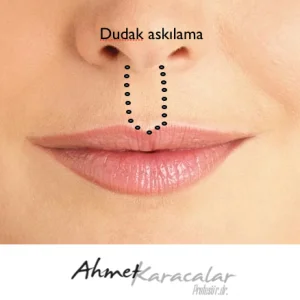
Especially after the age of 50, as the lip-nose distance lengthens, the upper teeth start to become less visible. Meanwhile, the lower lip loses its strength and the lower teeth become more visible. A long upper lip distance is sometimes structural and can be seen at younger ages. After some nose aesthetic operations, the upper lip lengthens due to the loosening of the lip-nose connection.
The elongation of the upper lip disrupts the proportions of the midface and gives the face an aged appearance. Along with the elongation, the upper lip thins and turns inward. Usually, vertical lines above the lip accompany this problem.
In treatment, lip threading is a quick and easy method. The sagging or elongated lip is fixed to the root of the nose with threads. Excess skin is removed by hiding the scars at the base of the nose. With this procedure, the lip-nose distance shortens, the upper teeth start to become visible, and the lip takes on a pleasant outward curve.
Below is a sketch regarding the removal of the excess portion from the upper lip according to the lower lip-chin tip ratios during the operation.

Dynamic aesthetics and lip fillers
Aesthetic surgical procedures should be compatible with a person's expressions and movements. Otherwise, the result that looks beautiful in a fixed position may change and deteriorate while smiling, talking, or during any expression. This situation becomes another reason for incompatible or artificial aesthetics.
This important approach, which we call dynamic aesthetics, gains particular importance for lip aesthetics.